
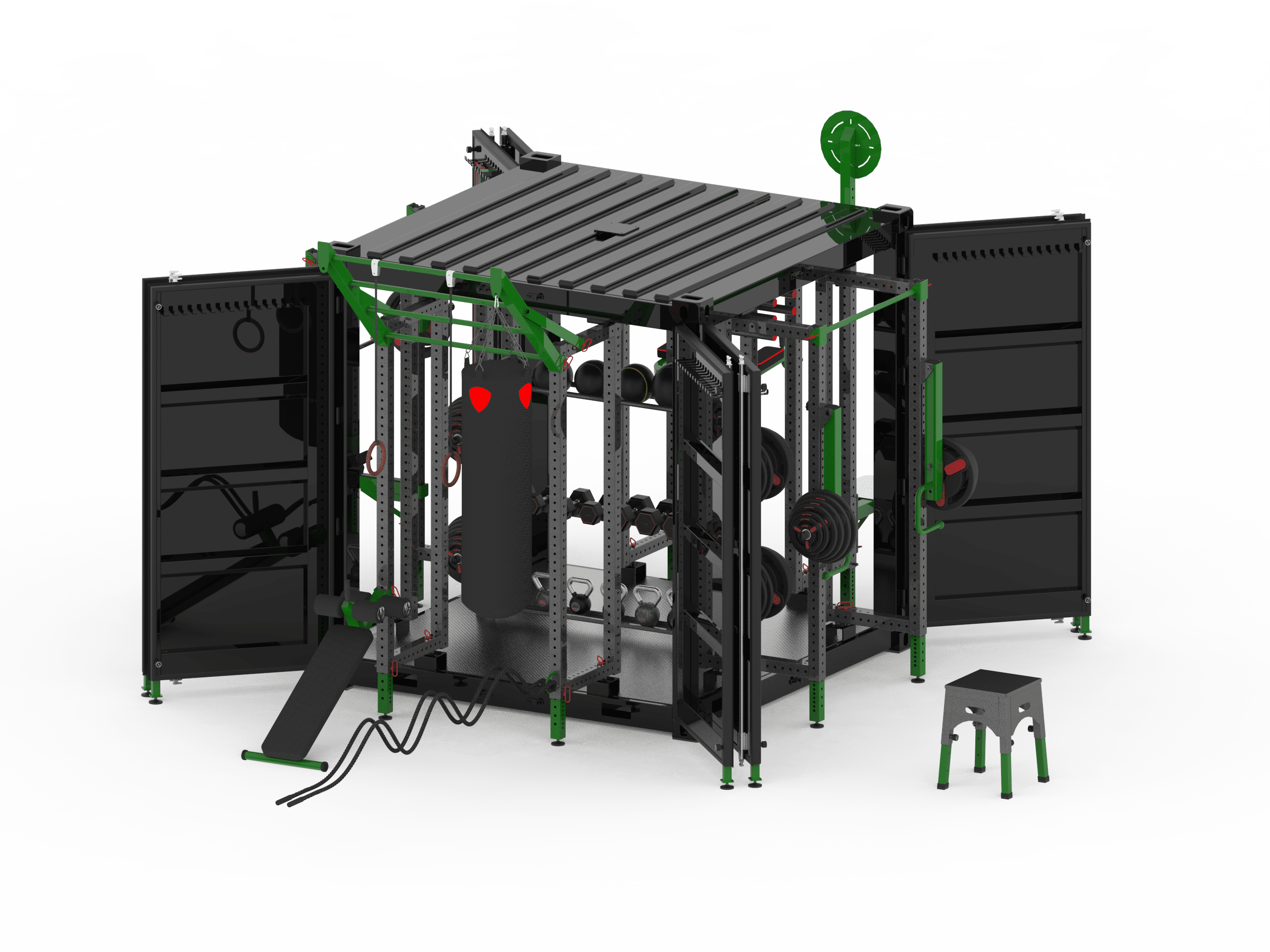

Every training facility project hits the same wall: time. A traditional gym build — design, permits, construction, fit-out, equipment installation — typically takes six months to a year before the first member walks in. For military units, resorts, schools, remote industrial sites and fitness entrepreneurs, that timeline kills good projects.
There is a faster path. A mobile container gym turns the entire facility into a product: a fully equipped training space built inside a 10ft or 20ft shipping container, delivered on a truck and ready to use almost immediately. Here is why it is the fastest way to deploy a training facility anywhere in the world.
What Is a Mobile Container Gym?
A mobile container gym is a complete training facility engineered inside an ISO shipping container. The interior is insulated, ventilated, lit and floored; the equipment package — racks, benches, barbells, storage and conditioning tools — is pre-installed at the factory. The unit arrives at your site as a finished product, not a construction project.
Because the entire build happens in a manufacturing environment instead of on your site, quality is controlled the same way as any precision-engineered product — and the on-site work shrinks to placement and power connection.
5 Reasons a Container Gym Deploys Faster Than Any Traditional Build
1. No construction phase
There is nothing to build. No foundations beyond a level surface, no interior fit-out, no coordination of electricians, flooring contractors and equipment installers. The most complex on-site task is putting the container down where you want it.
2. Factory-fitted, not site-fitted
In a traditional project, the gym is assembled piece by piece on location — which is where delays live. A mobile container gym is fitted out entirely at the factory: equipment is bolted down, wiring is run, flooring is laid and inspected before the container ever leaves production. What arrives is tested and complete.
3. Plug-and-play utilities
Connect standard electrical power and the facility is live — lighting, ventilation and outlets are already installed and tested. There is no mechanical room to build and no services to commission.
4. Minimal site requirements
A level, load-bearing surface roughly the footprint of the container is all that is needed. In many locations, a temporary or relocatable training unit also faces far lighter permitting requirements than a permanent building — which can remove months from a project before it even starts. (Always check local regulations for your site.)
5. It moves when you move
A traditional gym is a permanent investment; a container gym is a reusable one. When a project ends, the unit loads back onto a truck and deploys to the next site. For military units, event companies and growing businesses, the facility becomes an asset that keeps working — not a sunk cost.
Who Deploys Mobile Container Gyms?
- Military and tactical units — strength and conditioning capability at bases, forward positions and training grounds, deployable wherever the mission goes.
- Resorts, hotels and glamping sites — a premium fitness amenity delivered as a single unit, with no construction disturbing guests.
- Schools and universities — training space where campus land or buildings are unavailable, expandable as programs grow.
- Remote industrial and mining sites — worker fitness and wellbeing facilities at locations where building anything is difficult.
- Events and fitness entrepreneurs — pop-up training experiences and mobile coaching businesses that relocate with demand.
What to Look for in a Mobile Container Gym Manufacturer
Not all container gyms are equal. Before you buy, press your supplier on these details:
- Insulation and ventilation — a steel box in direct sun becomes an oven; proper insulation and powered ventilation are non-negotiable.
- Equipment integration — racks and storage should be engineered and bolted to the container structure at the factory, not loosely placed inside.
- Flooring and drainage — rubber flooring rated for dropped weights, sealed against moisture.
- Electrical pre-wiring — certified, tested, ready for your region’s voltage.
- Customization capability — layouts, equipment mixes, exterior branding and interior finishes should be configurable, not fixed.
From Drawing to Training in Weeks
Because design, fabrication, equipment integration and finishing all happen under one roof, a typical container gym project moves from confirmed drawings through production and delivery in a matter of weeks — plus shipping time to your region. Compare that with any conventional build and the advantage is obvious.
At YHFITNESS, we design and manufacture our Mobile Gym System line end to end — from structural engineering and interior fit-out to the factory-installed equipment package — in 10ft and 20ft configurations:
- Explore the 10ft Mobile Container Gym
- Explore the 20ft Mobile Container Gym
Planning a deployment? Request a quote and tell us your site, your users and your timeline — our engineering team will configure the right unit for it.

